
Most people approach buying security cameras the same way. They look at specs, resolution, night vision, etc., zeroing in on every minute detail before pulling the trigger two weeks later.
Or…
They just default to “We probably just need more cameras” and buy the cheapest ones they can find.
What both of these examples miss is that shopping for surveillance cameras isn’t like shopping for an iPhone and picking the most expensive or spec-heavy model. The secret is shopping for the right type of camera for the right job.
Not all surveillance cameras are built the same. If you buy the wrong one and put it in the wrong place, you can end up with blind spots, missed details, or coverage that doesn’t actually help you when you need it.
In this blog, we’re going to break down the differences between fixed, PTZ, and 360 cameras. What is each one designed for? Where do they work best? And which one is right for your business?
The Mistake We See All the Time
When camera systems don’t do what you need them to, it’s usually not about the hardware. They fail because of how they’re planned.
When we check out a property, we see the same patterns over and over again: Too many cameras covering the same areas, not enough coverage where it actually matters, or one “do it all” camera that’s expected to cover all the important bases.
On paper, it’s fine. The cameras are installed, the system’s up and running. What’s the big deal?
Most issues won’t pop up until you actually go back and review something. Maybe you’ll notice the way the angle isn’t quite right or the detail you were expecting isn’t there. Sometimes, we’ve even seen cameras that weren’t looking where it needed to be.
This is what happens when you choose surveillance cameras based on features instead of function.
If you want to learn exactly how to choose the right cameras for your property, keep reading.
Ask Yourself: What Do I Need?
Before we get into different camera types, let’s take a step back.
Ask yourself: What are you trying to see?
- People at the entrance of your business
- Monitoring activity over a large open area
- Tracking movement through a parking lot
- License plates of anyone entering your property
- Shared spaces
These are all different problems that don’t get solved the same way. There’s also a huge difference between coverage and detail.
Some cameras are meant to watch everything that’s happening in a space. Others are meant to capture enough clarity to actually identify what you’re looking at. If you don’t define that upfront, it’s easy to end up with a system that technically “covers” an area, but doesn’t give you anything useful when you need it.
This is exactly why camera choice should follow the environment, not the other way around.
Now, let’s get into the different camera types.
What Are Fixed Cameras?
Fixed cameras are the most straightforward type you can use because all they do is point in one direction and stay there. No movement or adjustment post-installation. Where you aim them is what they capture.
While this doesn’t sound very exciting, this is what actually makes fixed cameras so reliable.
They’re always watching the same area, and this makes them ideal for areas where you need consistent, uninterrupted coverage. Think entrances, hallways, or perimeter lines. Put fixed cameras anywhere you know exactly what needs to be in frame.
The only time we only get complaints about these is when businesses expect them to do more than they’re designed to do. For example, a fixed camera won’t follow movement, and it won’t adjust if something happens just outside its field of view. If it’s not positioned correctly right from the start, you’re going to miss things.
However, when intentionally placed, fixed cameras form the foundation of a solid system.
What are PTZ Cameras?
The point of these cameras is all in the name: Pan, Tilt, and Zoom.
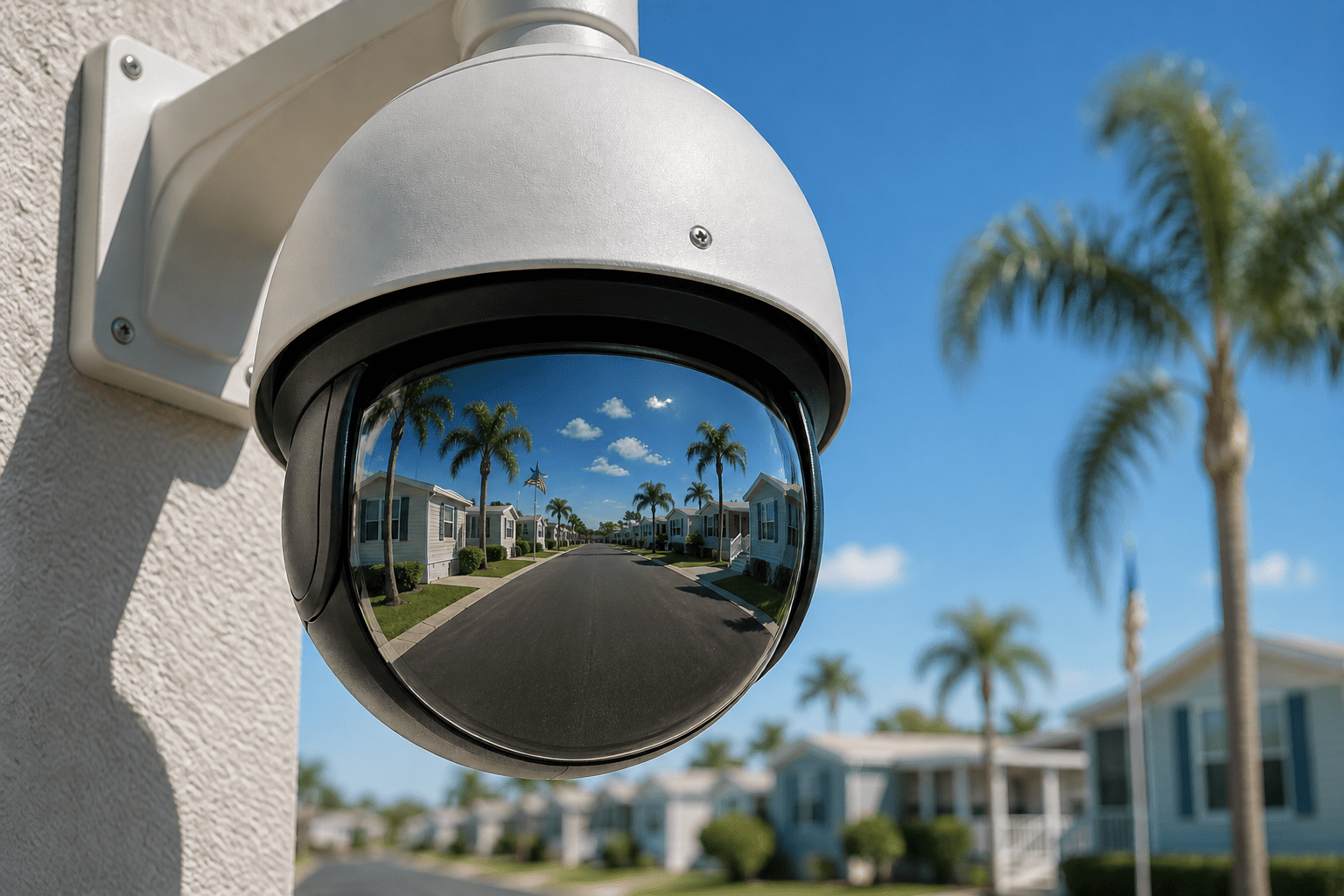
These are like the “M” (James Bond reference) of the surveillance camera world. They can move, adjust their angle, and zoom into specific areas. Some even track motion and can detect license plates.
This flexibility and all-seeing capabilities make them especially useful for parking lots, large outdoor areas, or anywhere that you need the ability to zoom in and follow activity. Sounds amazing, right?
Yet this is where a lot of people get it wrong.
An important thing to remember about PTZ cameras is that they can only look at one place at a time. If it’s zoomed into one area, it’s not watching anything else. And if there’s no one behind the scenes actively controlling it (or the tracking isn’t set up correctly), it can easily miss something happening just outside its view.
This is exactly why PTZ cameras don’t replace fixed cameras; they complement them.
When used correctly, they are capable of giving you minute detail where you need it. Used incorrectly, and you’re left with blind spots worse than a Chevy Camaro.
What Are 360 Cameras?
Rotate your desk chair 360 degrees. You saw your whole space, right?
This is exactly what 360 cameras are designed to do: capture everything in a single, 360-degree view.
Instead of pointing in one direction, they use a fisheye lens to cover an entire area, typically from a ceiling-mounted position. This is what makes these cameras especially suited to open spaces where activity isn’t limited to one direction.
Think lobbies, common areas, shared spaces, or large rooms.
But there’s a tradeoff, and you might have already guessed what that tradeoff is.
Because that view is spread across such a wide area, you’re not getting the same level of detail you would from a more focused camera. While yes, you absolutely can zoom in after the fact, it’s not the same as having a camera already pointed at that exact spot.
So, while these are fantastic for visibility, they’re not necessarily the best choice when you need clear identification. They show you everything, just not in the level of detail you might expect.
Fixed, PTZ, or 360: Which One is Right For Your Business?
By now, you might be thinking, “I’ll just put fixed cameras everywhere”, or “The obvious answer is one PTZ to cover it all”. Maybe you’re thinking, “I’ll just install a few 360 cameras and call it a day!”
But that’s not how these systems are meant to work. The truth is, most properties need variety in their surveillance camera setup.
Fixed cameras for hallways
PTZ cameras for your parking lot
360 cameras in the break room and reception area
Think of it like this: Fixed cameras handle consistent coverage in areas you always need to see. PTZ cameras handle those little details you also need to see. 360 cameras cover open spaces where you really don’t want blind spots.
Each one has a job. You wouldn’t want your accountant handling your IT, would you?
Exactly.
We aren’t trying to find the “best” camera; we’re building a system where each camera type supports the others. Only then will you have the coverage, the angles, and the detail to actually see what you need to see.
Overwhelmed? We Can Help
If you’re new to shopping for surveillance cameras, all of this information might feel a little overwhelming. The good news is that if you’ve made it this far, you already sort of know what you need, but actually buying and installing them is a different story.
That’s what we’re here for. At Network Thinking Solutions, this is what we do every day for businesses just like yours.
We work with Ubiquiti (UniFi) systems to design and implement camera setups that fit your property and your visibility goals. This means planning coverage, choosing the right mix of cameras, installing, and making sure everything is set up in a way that’s actually useful when you go back and review footage.
If you’re not sure what your setup should look like, or you’re starting from scratch, we can help you map it out and get it right from the beginning.
Ready to take your visibility to the next level? Contact us.