
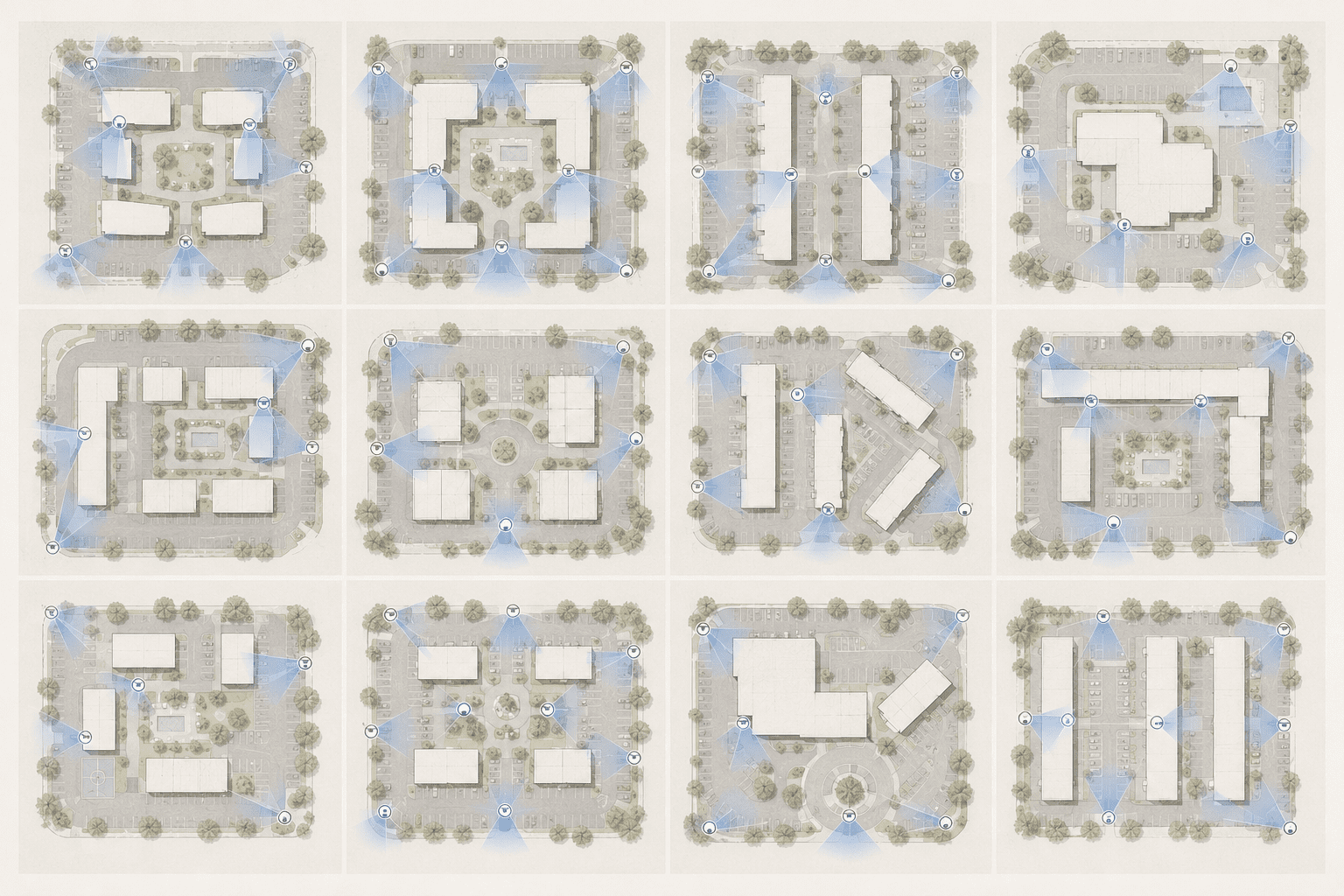
Most surveillance camera systems look “fine” until you actually need them. That’s especially true in real estate and manufactured housing where you’re managing multiple communities at once.
No two properties are exactly the same. You have different layouts, different entry points, different parking lot setups, and different shared spaces to cover. So what ends up happening is every location gets set up a little differently.
What you can see in one community, you can’t see in another. One property has usable footage while the others don’t. What you thought was a camera problem is actually a system problem. So, what should you do in this situation?
In this blog, we’re going to walk you through how to design a camera system that actually works across multiple communities. What to prioritize, how to stay consistent, and where most setups fall short and bite you later.
The Surveillance Mistake We See All the Time
Most multi-location camera systems fail because there’s no consistency behind them, not because of the cameras themselves.
In real estate and manufactured housing, each community tends to get handled differently. For example, one property gets a full, well-thought-out setup and another has cameras added over time. A third may end up with whatever made sense in the moment. In the end, you get different vendors, different camera systems, and different levels of coverage.
Do you see the problem here?
On paper, everything looks fine, every location “has cameras”. Every location is secure, right?
The reality is, this doesn’t hold up when you actually need to use the system. That’s when the cracks start to show. One property might have a clear view of the entrance, while another barely covers it. At one location, you can zoom in and get real detail, but at the other, the footage isn’t useful enough to act on.
This goes beyond a security issue. It’s actually a liability issue that could cost you later.
If the problem isn’t the hardware, what are we dealing with? Each location was treated like its own project instead of a larger system. We don’t want that.
The Foundation of Your Surveillance System
The shift here is pretty simple: Instead of designing for one community, you’re designing for all of them.
This means stepping back from individual layouts for a second and thinking about what needs to be consistent across every property. Not identical (because no two communities are exactly the same), but consistent in how coverage is approached.
Ask yourself:
What do you expect to see at every entrance?
What level of detail do you need in parking areas?
How do you want shared spaces to be monitored?
The answers to these questions shouldn’t change much from one location to the next. The goal is to know that, no matter which property you’re looking at, you’re getting the same level of visibility and the same ability to go back and review something confidently.
Once the foundation is clear, everything else should fall into place a lot more smoothly.
But wait, don’t go buying cameras yet; we still have a few more bases to cover.
So, what’s our next step?
Start With the Areas That Actually Matter
Believe it or not, this is where a lot of systems fall off the rails. The instinct is to try to cover every angle, corner, or possible scenario at once, but we’re asking you to slow down for a minute. Rome wasn’t built in a day, and neither is a great surveillance plan.
Start with the areas that matter most. But beware, starting with “everything” usually leads to a system that might feel complete but isn’t actually effective.
In real estate and manufactured housing, your matter-most areas usually boil down to a few key points: Where people come in and out, where cars come and go, and where your residents and visitors spend the most time.
Unfortunately, this is where most issues happen and where you really need to be able to go back and actually see what happened.
Once you’ve got these locations written down, everything else becomes easier to layer on.
How to Choose the Right Surveillance Cameras (and Where They Go)
Once you know your key areas, the next step is deciding how those areas should be covered.
This is where camera choice becomes the main character, but it’s also the area that can get confusing. The key thing to keep in mind is that different camera types are designed for different jobs. When they’re used intentionally, they work together. When they’re used interchangeably, you end up with gaps.
Let’s break it down so you don’t pull your hair out when the time comes:
Fixed cameras: These cameras give you consistent, reliable coverage. They’re usually a good choice for entrances, exits, and anywhere you know exactly what needs to be in frame. They don’t move at all, which is kind of the point. They’re always watching the same area.
PTZ (pan, tilt, zoom) cameras: These are better suited for larger spaces where you need flexibility. Parking lots are a great example. PTZ cameras give you the ability to zoom in and follow activity, but they’re not meant to replace fixed cameras; they’re meant to complement them.
180 & 360 cameras: These are your wider coverage options. The goal with these is visibility across an entire space. Put these in shared areas where activity isn’t happening in just one direction. They do come with tradeoffs, though.
The key is not to pick one type and it use it everywhere; you’re trying to match the camera to the environment.
When that’s done right, you’re designing for what you want to see.
If you want to learn more about different camera types and what they’re used for, check out this blog.
Consistency Across Every Location is Key
Once you know how different areas should be covered, and you’ve picked the right surveillance cameras for those locations, that approach needs to carry across every property.
An entrance at one community should be covered the same way as the entrance at another. Parking areas should follow the same logic. Shared spaces should be treated the same, even if the layout is different.
That consistency is exactly what makes the surveillance system usable.
When something happens, you’ll already know what to expect, where to look, what the footage should show, and how to navigate it.
It also makes everything easier to manage over time. Expanding to new properties, replacing equipment, reviewing incidents…it all becomes more straightforward because you’re not dealing with a completely different setup at every location.
Without consistency, even a well-installed system starts to break down at scale.
Make Time for Your Safety Net
Designing a camera system across multiple communities isn’t something most teams have the time (or the context) to get right on their own.
You need to know what to prioritize, how to stay consistent across all properties, and how to build a camera system that actually holds up as you grow. It isn’t just about choosing cameras.
This is exactly where we come in. At Network Thinking Solutions, we design and implement camera systems that are built to scale. We work with Ubiquiti (UniFi) to create consistent, reliable setups across every location so you’re not dealing with a different experience at every property.
We’ll map out the right approach, handle the details, and take care of installation so you don’t have to piece it together property by property.
If you’re planning a new system or trying to make sense of what you already have, we can help you get it set up the right way from the start. Contact us to schedule your complimentary consultation today.