
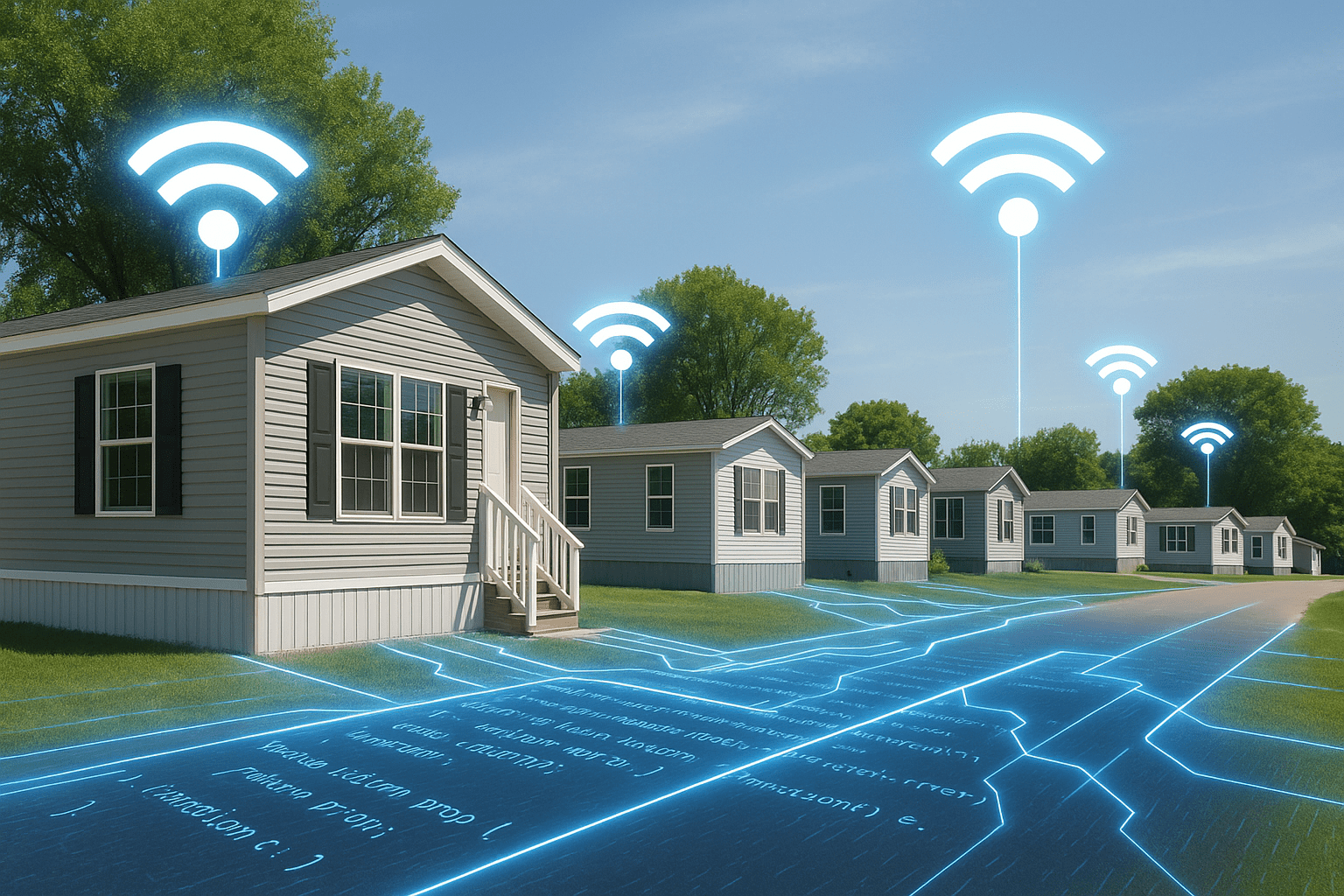
Every part of a modern manufactured housing business runs on connectivity.
Leasing systems, rent payments, maintenance requests, security cameras, vendor portals, resident communications… the list feels endless
None of it works if the network underneath it is slow, unreliable, or unsecured.
For a long time, WiFi was treated like a utility. Something you set up once and forget about. But today, it’s become something much bigger. Your network is the backbone of how your communities operate, how money moves, and how your people get work done.
When it fails, everything feels it. When it’s exposed, the risk spreads far beyond IT.
That’s why WiFi is no longer just internet; it’s infrastructure.
In this blog, we’re going to explore how network gaps create security and financial risk, and how you can close them without disrupting operations.
How WiFi quietly affects everything
Most people only think about WiFi when it breaks. But in a manufactured housing operation, the network is involved in almost every part of the business, even when it’s working in the background.
Property managers rely on it to access leasing, accounting, and resident management systems.
Maintenance teams use it to receive work orders, update job status, and coordinate across communities.
Corporate teams depend on it for reporting, vendor coordination, compliance, and financial visibility. Security cameras, access controls, and payment portals all run on the same network.
When that connection is slow, unstable, or badly secured, the impact shows up in ways that are easy to overlook but expensive to live with. Calls drop, systems lag, transactions fail, staff lose time, data becomes harder to trust, and small gaps in the network can turn into serious security exposures.
In a distributed business like manufactured housing, where teams are spread across dozens of properties and locations, those issues multiply quickly. A weak network in one community doesn’t just affect that site; it also affects reporting, resident experience, and operational efficiency across the organization.
This is exactly why WiFi isn’t just about coverage or convenience anymore.
Why this matters more than most teams realize
In most manufactured housing organizations, the network wasn’t thoughtfully designed from the start. It evolved over time as the business grew. New communities were added, new systems were introduced, and tools were layered on to solve immediate needs.
What began as a simple WiFi setup gradually became the backbone of daily operations, even though it was never intended to support that level of complexity.
As staff are rotated in and out, vendors need access, and more systems get connected. The network expands quietly in the background. Over time, visibility fades. Leadership no longer has a clear picture of what was connected or how data was moving, and IT teams tend to become reactive because they’re spending their time putting out fires instead of planning ahead.
The problem really crests when performance issues and outages start to feel routine, and security gaps remain invisible until something goes wrong.
This is why network problems are often dismissed as “IT issues,” even though the impact is felt far beyond the IT department.
When a network isn’t built to support how the business actually operates, the consequences show up in delayed work, frustrated teams, disrupted residents, and unnecessary risk. The technology may be invisible, but the cost of getting it wrong never is.
What manufactured housing operators can do about it
The first step is recognizing that the network is no longer just a background utility. It’s core infrastructure, whether it was designed that way or not. When communities expand, systems multiply, and staff and vendors rotate in and out, the network needs to be revisited intentionally, not just patched to keep things moving.
That starts with understanding what’s truly connected today and how those connections support daily operations. Many organizations are surprised by how much access still exists, how many systems rely on each other, and how little visibility they have into traffic and performance across properties. Gaining that clarity makes it easier to spot risks early and address issues before they turn into outages or security problems.
Once visibility improves, IT teams can shift out of constant reaction mode. Instead of scrambling to fix slowdowns, dropped connections, or unexplained issues, they can plan for stability, growth, and security. That shift alone reduces disruption across operations, finance, and resident services.
When the network is treated like the operational backbone it has become, it stops quietly working against the business. It becomes something leadership can rely on, teams can trust, and residents never have to think about.
That’s exactly how it should be.
More than a solution
At this stage, the problem isn’t awareness. Most manufactured housing organizations already feel the strain when systems slow down, access gets messy, or something breaks at the worst possible time. The challenge is knowing where to start and how to fix it without throwing a wrench in day-to-day operations.
This is where an outside perspective makes a difference. When you step back and look at the network as a whole, patterns emerge. Gaps become easier to identify. Small changes start to carry real impact. Instead of guessing, you can make decisions based on how the network actually supports your communities today.
This is why taking a closer look at your network can be one of the most practical things you do for your business. Not to replace everything or make things more complicated, but to understand what is actually supporting your operations today and where it might be worth making a few smart changes.
If you’re planning to be at TexCo on February 12, we’ll be there and would be glad to talk through what that looks like for your community. Schedule your on-site meeting with us today!