
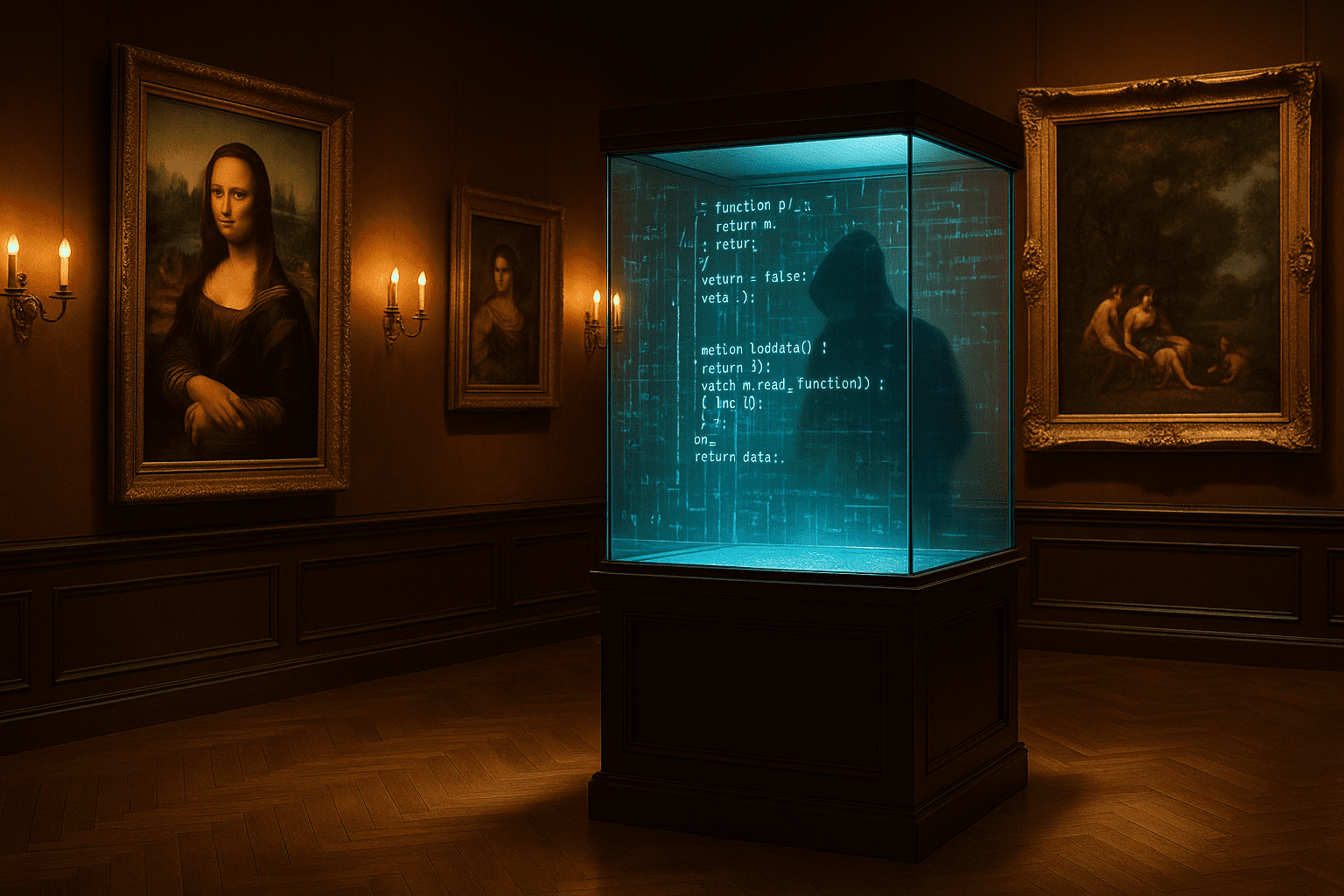
It took just seven minutes to rob the most famous museum in the world. Let that sink in.
On the morning of October 19, 2025, four masked thieves arrived at the Louvre dressed as construction workers. They raised a ladder to a second-floor balcony, cut through a window, and smashed open two display cases in the Apollo Gallery, just a few rooms away from the Mona Lisa.
By the time the alarm went off, they were gone. Eight pieces of jewelry worth $102 million had vanished, and the world was left asking how a museum this famous and this supposedly secure could be robbed in broad daylight.
The answer is simple: they didn’t need more guards or thicker glass because the thieves didn’t overpower the system at all.
They outsmarted it.
That’s exactly what happens in most cyberattacks today.
The modern cyber thief doesn’t need a ladder or a getaway car. All they need is a stolen password and a few seconds of distraction to break into your business and steal your crown jewels.
In this blog, we’re going to dive into how the Louvre thieves did it, and what you can do as a business to protect your most important assets.
What cybercriminals learned from the Louvre heist
The Louvre heist was fast, calculated, and quiet. No alarms until it was too late. No chaos, no confrontation, no drama. Just precision and great timing (for the thieves).
Cybercriminals operate in much the same way. They don’t break in with noise and force, they don’t make a big to-do about breaking your digital defenses; they slip in quietly through unguarded doors like a weak password, a missed update, an employee who clicks a link without thinking.
It’s the silent killer because you won’t know they’ve broken in until it’s too late.
Think about the sequence of that morning in Paris.
9:30 a.m.: The thieves arrived with a ladder. In cyber terms, that’s reconnaissance: learning your systems and studying how your business operates.
9:34 a.m.: They cut through the window and smashed display cases. That’s exploitation. A phishing link clicked, a password reused, an access point opened.
9:37 a.m.: The alarm sounded. In cybersecurity, that’s the moment you realize something’s wrong, usually after the damage is already done.
9:38 a.m.: They were gone, leaving nothing behind but Empress Eugenie’s damaged crown lying on the ground. Hackers don’t stick around either, and they don’t leave priceless artifacts in their wake. They move fast, encrypt data, drain accounts, and disappear.
The Louvre’s mistake was a lack of visibility, not security. The world’s most famous museum had strong defenses (or seemingly strong, because they likely thought no one in their right mind would try to steal from them), but their response time turned out to be the real Achilles heel.
The same is true for many businesses today. The locks are there, but no one’s watching the door.
The modern heist is digital
Cybercriminals don’t need masks, motorbikes, or proximity to your business. They don’t need to cut through glass or dodge alarms. They could be sitting in a grimy room on the other side of the world, and all they need is decent wifi and access to your system.
The thing about access is, it starts with a password.
Phishing emails, stolen credentials, and fake login pages are the new lockpicks. Your data, your money, and your reputation are the new heist.
Once a hacker gets inside your network, they move silently and fast. They read your emails, learn your workflows, and wait for the perfect moment to strike, often by rerouting payments or stealing sensitive data before anyone notices.
The difference between a seven-minute museum heist and a seven-second data breach isn’t the method, it’s the medium.
One happens behind marble walls, the other happens in the dusty corners of your tech that you haven’t looked at in a while.
And while the Louvre had insurance for its art, most SMBs don’t have the same safety net (yes, cybersecurity insurance exists. If you don’t have it, definitely look into it.).
Cybercrime does a lot more than steal your sensitive data. It obliterates trust, has the potential to drain accounts, and ruins the reputation you worked so hard to build.
The Louvre will still have camera-toting tourists stalking their draped and marbled halls despite the heist, but for an SMB, it could mean “closed for business.”…for good.
The lesson: prevention is faster than response
When the Louvre’s alarm sounded, the theft was already over.
By the time the police arrived, the thieves were gone, leaving behind only tools, debris, and one damaged crown.
In cybersecurity, the same pattern repeats every day. Businesses invest in protection, but the alert doesn’t come until the breach is complete. The difference between recovery and prevention often comes down to seconds and awareness.
You can’t stop what you can’t see unless your name is Clark Kent and you daylight as a reporter at The Daily Planet.
That’s why visibility matters more than any single tool. The companies that avoid damage aren’t the ones with the most expensive firewalls (or we wouldn’t see so many Fortune 1000 breaches), they’re the ones who know exactly where their vulnerabilities are and can fix them fast before someone else finds them.
Simple steps like enabling multi-factor authentication (MFA), training employees to spot phishing attempts, and keeping systems patched make it harder for thieves to slip through unnoticed.
In the end, the Louvre didn’t fail because it lacked security. It failed because it reacted too late.
Protect your digital masterpieces
If you’re not in the cybersecurity world, all of this can sound overwhelming, like a bad game of whack-a-mole that’s rigged against you. Every time you think you’ve plugged one hole, a new threat pops up somewhere else.
Somehow, you’re expected to keep up with it all while still running your business.
You’re not alone in feeling that way. The pace of cybercrime moves faster than most companies can react, and that’s exactly what attackers count on. They take advantage of distraction, limited bandwidth, and the assumption that “we’re too small to be a target.”
At Network Thinking Solutions (NTS), we help businesses like yours break that cycle. Our job is to simplify cybersecurity, strengthen your defenses, and give you visibility into your systems so you’re never caught off guard.
We monitor for threats before they become emergencies, keep your data protected, and make cybersecurity feel like something you can actually manage, instead of just reacting to issues as they happen.
Because the truth is, you don’t need to know everything about cybersecurity to stay safe, you just need a partner who does.
Let’s protect your business like it’s the Louvre before someone tries to walk out with your crown jewels.
Schedule your free cybersecurity assessment today.